EIP-8125: Temporary Contract Storage
Adds bounded-lifetime contract storage via TMPLOAD/TMPSTORE opcodes that is automatically cleared on a fixed schedule.
| Authors | Wei Han Ng (@weiihann) |
|---|---|
| Created | 2026-01-14 |
| Discussion Link | https://ethereum-magicians.org/t/eip8125-temporary-contract-storage/27440 |
| Requires | EIP-2200, EIP-2929 |
Table of Contents
Abstract
This EIP introduces temporary storage: a new contract-accessible key-value store that persists across transactions and blocks, but is automatically cleared at a protocol-defined schedule. Two new opcodes are added:
TMPSTORE(key, value)to write temporary storage for the executing contract.TMPLOAD(key)to read temporary storage for the executing contract.
Temporary storage is intended for data that does not need indefinite retention, providing a safer alternative to using permanent state for ephemeral data and enabling bounded growth of this class of state.
Motivation
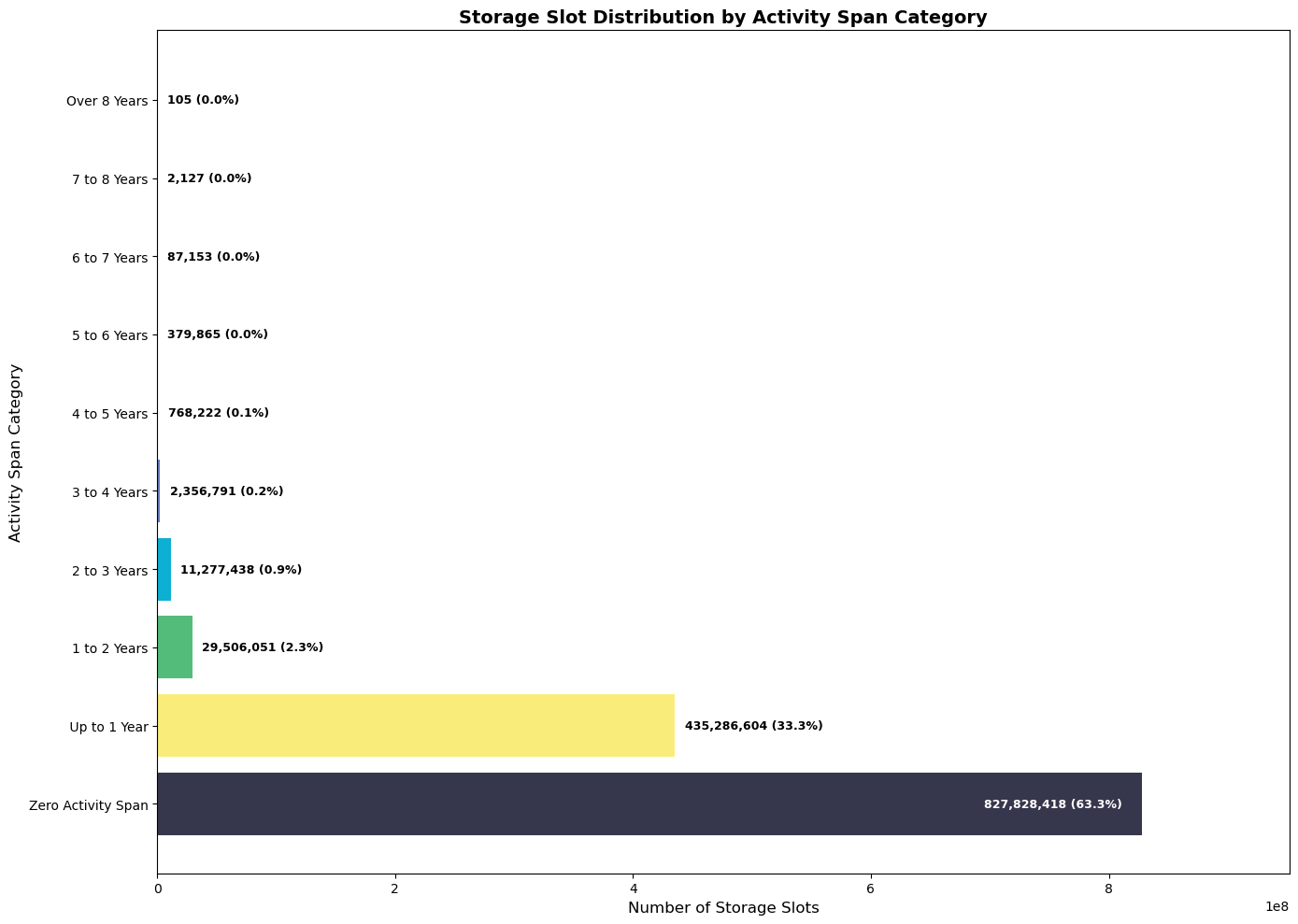
Figure 1: Over 60% of the storage slots are written once and never accessed again onchain.
Permanent contract storage is costly because it increases long-term node resource requirements (disk, I/O, state maintenance). However, many applications write data that is only valuable for a bounded time window.
This EIP provides:
- Bounded lifetime semantics without requiring explicit deletes.
- Predictable clearing that can be relied upon at the application layer.
- A building block for reducing state growth created by ephemeral use cases.
Specification
The key words “MUST”, “MUST NOT”, “REQUIRED”, “SHALL”, “SHALL NOT”, “SHOULD”, “SHOULD NOT”, “RECOMMENDED”, “NOT RECOMMENDED”, “MAY”, and “OPTIONAL” in this document are to be interpreted as described in RFC 2119 and RFC 8174.
Constants and parameters
| Name | Value | Description |
|---|---|---|
FORK_BLOCK |
TBD | Activation block of this EIP |
TEMP_STORAGE_PERIOD |
TBD | The number of blocks that the temporary storage holds for a given period |
TEMP_STORAGE_SYSTEM_ADDRESS_0 |
TBD | First reserved address used to store temporary storage |
TEMP_STORAGE_SYSTEM_ADDRESS_1 |
TBD | Second reserved address used to store temporary storage |
TMPLOAD_GAS |
TBD | The gas cost of a warm read at temporary storage slot |
COLD_TMPLOAD_COST |
TBD | The gas cost surchage of a cold access at the temporary storage |
TMPSTORE_SET_GAS |
TBD | The gas cost of setting a slot from zero to non-zero at the temporary storage |
TMPSTORE_RESET_GAS |
TBD | The gas cost of changing a non-zero slot to another value at the temporary storage |
Temporary storage data model
Temporary storage is backed by two reserved system accounts at TEMP_STORAGE_SYSTEM_ADDRESS_0 and TEMP_STORAGE_SYSTEM_ADDRESS_1.
The temporary storage keyspace is a mapping of (contract_address, key) -> value, where:
derived_slot_key = keccak256(contract_address || key)
Temporary storage values are stored in the regular storage tries of the system accounts using derived_slot_key as the slot key.
Periodic rollover (storage reset)
Temporary storage is organized into periods, each of length TEMP_STORAGE_PERIOD blocks after activation.
For blocks with block.number >= FORK_BLOCK, define:
period_index(block_number) = floor((block_number - FORK_BLOCK) / TEMP_STORAGE_PERIOD)
Define the current and previous system accounts for a block B (where B.number >= FORK_BLOCK) as:
current_index = period_index(B.number) % 2

if current_index == 0:
    CURRENT_SYSADDR = TEMP_STORAGE_SYSTEM_ADDRESS_0
    PREVIOUS_SYSADDR = TEMP_STORAGE_SYSTEM_ADDRESS_1
else if current_index == 1:
    CURRENT_SYSADDR = TEMP_STORAGE_SYSTEM_ADDRESS_1
    PREVIOUS_SYSADDR = TEMP_STORAGE_SYSTEM_ADDRESS_0
At the first block of each new period, the protocol MUST clear the storage of the system account that becomes the current.
When processing a block B (with parent P) where both are >= FORK_BLOCK, if period_index(B.number) > period_index(P.number), then before executing transactions in B, the protocol MUST perform:
CURRENT_SYSADDR.storageRoot = EMPTY_TRIE_ROOT
where CURRENT_SYSADDR is computed from B.number as specified above.
No other accounts are modified by the rollover.
Effect: After rollover, entries written in the immediately previous period remain readable via PREVIOUS_SYSADDR for one additional period, while entries older than one period are removed.
New opcodes
Add 2 new opcodes as follows:
TMPLOAD(key)
Compute derived_slot_key from (contract_address, key). Then load derived_slot_key from CURRENT_SYSADDR first. If it doesn’t exist (i.e. value == 0 ), then load derived_slot_key from PREV_SYSADDR.
TMPSTORE(key,value)
Compute derived_slot_key from (contract_address, key). Then:
- If
value != 0, store in the storage ofCURRENT_SYSADDR. - If
value == 0, delete slot from bothCURRENT_SYSADDRandPREV_SYSADDR.
Rationale: Because reads fall back from current to previous, clearing only the current store would allow an older previous-period value to be returned. Clearing both ensures TMPSTORE(key,0) makes subsequent TMPLOAD(key) return 0 (until a new non-zero is written).
The call rules should follow SSTORE and SLOAD.
The gas rules should follow the conventions in EIP-2929 and EIP-2200 referencing SSTORE and SLOAD, except that:
- The gas costs should be much lower than
SSTOREandSLOAD, but higher thanTSLOADandTSTORE - No refunds are given for clearing temporary storage
TMPLOADMAY perform up to 2 storage reads (current then previous). Gas MUST account for this behaviour.- Deletion in
TMPSTOREis more expensive than creation/modification as the storage root of both system accounts are updated. Gas MUST account for this behaviour.
Activation and reserved address
At FORK_BLOCK, the chain MUST treat TEMP_STORAGE_SYSTEM_ADDRESS_0 and TEMP_STORAGE_SYSTEM_ADDRESS_1 as reserved addresses:
- If either does not exist in the state trie, it is created with:
nonce = 1balance = 0codeHash = EMPTY_CODE_HASHstorageRoot = EMPTY_TRIE_ROOT
No contract code is deployed at this address.
Rationale
Why not just use transient storage (EIP-1153)?
EIP-1153 (transient storage) is discarded after every transaction, which is ideal for intra-tx operations. This EIP targets a different class of use cases where data must persist across multiple transactions/blocks, but does not need indefinite retention.
Why two-period rollover?
Two-period rollover provides a stronger usability guarantee:
- An entry is retained for at least one full
TEMP_STORAGE_PERIODafter it is written (it will be readable in the next period via the previous-period system account). - An entry is retained for at most two periods (once the current-period system account is cleared and reused).
This provides a simple mental model for contract developers. That is, if an entry is stored in temporary storage, it will at least last for TEMP_STORAGE_PERIOD.
In contrast, a single global rollover makes effective lifetime depend on when data is written within the period: a write near the end of a period could be cleared almost immediately, which may not be developer-friendly.
Why two system accounts?
Using two reserved system accounts allows constant-time rollover:
- At each period boundary, only the current-period system account is reset by setting a single
storageRoot = EMPTY_TRIE_ROOT. - The previous-period system account remains intact for one more period.
- Storage older than one period becomes unreachable and can be pruned.
Backwards Compatibility
This EIP requires a hard fork to implement.
It does not change behavior of any existing opcodes. Therefore, it is backward compatible with all existing contract accounts.
Security Considerations
- DoS surface: Temporary storage writes still create state that must be processed and stored for at least 1 period. Gas costs should be calibrated so that worst-case temp writes do not create new per-block disk I/O DoS attack vectors beyond existing storage writes.
- Reorg safety: Clients should retain sufficient history to handle plausible reorg depths.
- Application safety: Contracts MUST treat temp storage as ephemeral and handle the case where entries are unexpectedly missing.
Copyright
Copyright and related rights waived via CC0.
Citation
Please cite this document as:
Wei Han Ng (@weiihann), "EIP-8125: Temporary Contract Storage [DRAFT]," Ethereum Improvement Proposals, no. 8125, January 2026. Available: https://eips.ethereum.org/EIPS/eip-8125.