Compute operations to reprice in EIP-7904
Compute operations to reprice in EIP-7904
Maria Silva, January 2026
In this report, we present which operations should have a cost increase with EIP-7904 and describe the methodology to pick them. The analysis can be reproduced in the 0.5-gasbench_data_eda notebook.
Methodology
Data
The raw benchmark data was generated by running the EEST benchmark suite with the Nethermind benchmarking tooling. The database is hosted on a PostgreSQL server managed by the Nethermind team.
Each test was run multiple times to isolate random variations in runtime and outliers. The data was collected between 2026-01-05 and 2026-01-22.
The test are still using the Prague fork. A similar analysis is still needed for the Osaka fork.
All benchmarks were run on the performance branches of each client using the following hardware specification:
| Specification | Value |
|---|---|
| spec_processor_type | x86_64 |
| spec_system_os | Linux |
| spec_kernel_release | 6.8.0-53-generic |
| spec_kernel_version | #55-Ubuntu SMP PREEMPT_DYNAMIC |
| spec_machine_arch | x86_64 |
| spec_processor_arch | 64bit |
| spec_cpu_model | AMD EPYC 7713 64-Core Processor |
| spec_num_cpus | 32 |
Data processing
The raw benchmark data was processed as follows:
-
Parsing test metadata: Each test title was parsed to extract the test file, test name, test parameters, fork version, and the target opcode or precompile being tested.
-
Filtering invalid data: Tests with execution time of 0ms were excluded. The ethrex client was also excluded from the analysis as it is still in early development.
- Removing outliers: For each (client, test, opcode) combination, outliers were identified using the interquartile range (IQR) method:
- Lower threshold: Q1 - 1.5 × IQR
- Upper threshold: Q3 + 1.5 × IQR
- Data points outside these thresholds were flagged as outliers and excluded from the worst-case analysis.
-
Computing worst-case performance: For each (client, test, opcode) combination, the minimum non-outlier MGas/s value was selected to represent the worst-case execution performance.
- Aggregating by opcode: For each opcode, the worst-performing test across all clients was identified, along with the second-worst client’s performance on that same test.
Selecting candidates
Operations were selected as candidates for repricing based on the following criteria:
-
Performance threshold: The worst-case MGas/s must be below 60 MGas/s. By increase the costs of these operations, we will be able to increase our base throughput 3x from our current 20Mgas/s.
-
Multi-client validation: To avoid penalizing all clients for a single client’s implementation inefficiency, the second-worst client’s performance is also considered. If the second-worst client achieves significantly better performance (>20% above the threshold), the operation is flagged for client optimization rather than repricing.
-
Excluding very slow tests: Tests with worst-case MGas/s below 20 MGas/s were analyzed separately to understand if the slowness is due to specific test parameters or possible errors in data. After Osaka, we are running at 20Mgas/s, so we should not observe test with values lower than this.
Performance results
Run times distribution by client
The benchmark data covers 237,733 test runs across 5 clients (Besu, Erigon, Geth, Nethermind, and Reth) on the Prague fork. The overall distribution of MGas/s shows significant variation across tests and clients.
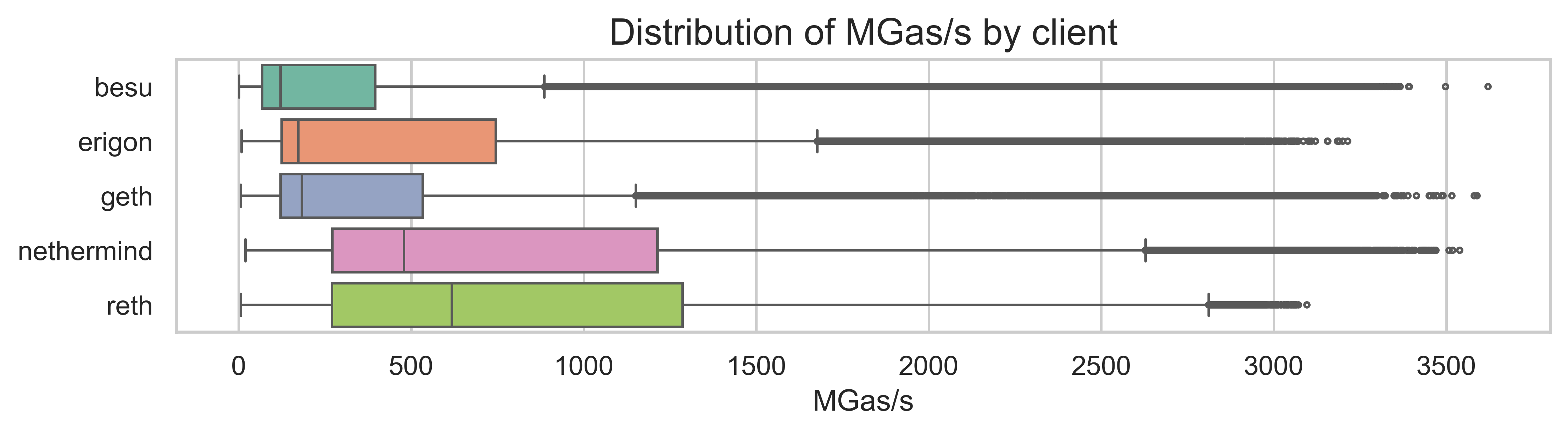
The boxplot above shows that different clients have different performance characteristics:
- Nethermind and Reth the highest median performance
- Besu shows a wider distribution with a majority of tests at lower MGas/s values
- Erigon and Geth have intermediate performance, with still some slower tests, but a higher median performance than Besu.
Worst vs. second-worst client
An important consideration for repricing is whether poor performance is isolated to a single client or affects multiple implementations. This is important for distinguishing between:
- Operations that genuinely need repricing (multiple clients struggle)
- Operations where a specific client needs optimization (only one client struggles)
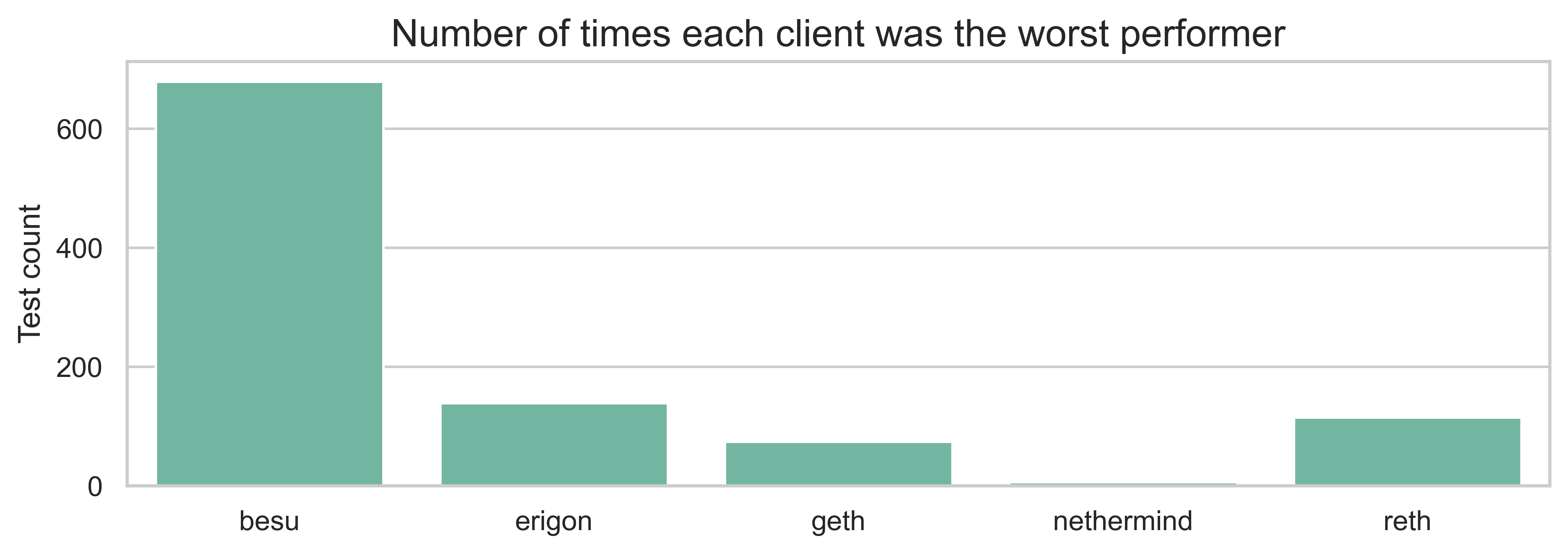
The chart shows the number of tests in which each client was the worst performer. We can see that Besu is the worst performer in the majority of tests, followed by Erigon.
The next plot shows the distribution of the performance ratio between the worst client and second-worst client. Each boxplot shows this distribution by the client (i.e., when each client is the worst performer).
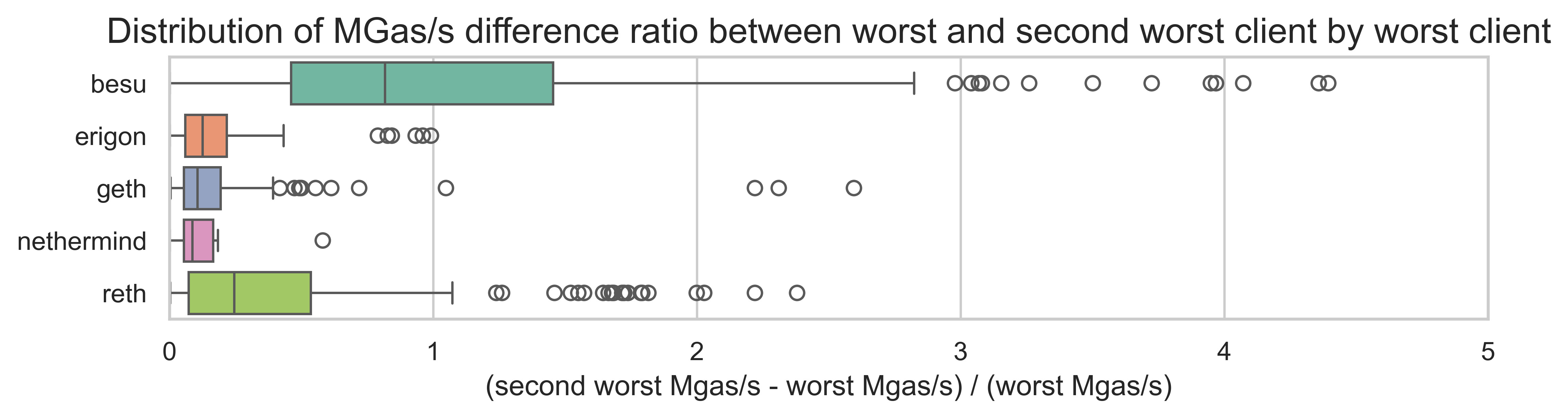
For a majority of tests, the gap between worst and second-worst is small (<20%), suggesting that the worst client is not significantly underperforming on relation to the other clients. However, we do see some tests with the gas is much wider. These test are more frequent for when Besu is the worst client.
Underpriced operations at 60 MGas/s
The following table shows operations with worst-case performance below 60 MGas/s:
| Operation | Type | Worst MGas/s | Worst Client | Second Worst MGas/s |
|---|---|---|---|---|
| MULMOD | opcode | 20.60 | besu | 57.02 |
| MODEXP | precompile | 21.63 | geth | 25.06 |
| EQ | opcode | 22.80 | besu | 122.96 |
| SDIV | opcode | 23.14 | besu | 85.18 |
| REVERT | opcode | 23.38 | besu | 110.41 |
| SMOD | opcode | 24.99 | besu | 67.98 |
| MOD | opcode | 25.27 | besu | 70.98 |
| SAR | opcode | 27.15 | besu | 134.36 |
| MUL | opcode | 27.60 | besu | 147.87 |
| SUB | opcode | 28.80 | besu | 122.66 |
| DIV | opcode | 29.94 | besu | 88.54 |
| SHIFT | opcode | 30.47 | besu | 124.32 |
| point evaluation | precompile | 31.75 | erigon | 31.85 |
| RETURN | opcode | 32.95 | besu | 103.85 |
| ADDMOD | opcode | 32.98 | besu | 91.12 |
| CALLCODE | opcode | 34.78 | besu | 112.96 |
| CALLDATALOAD | opcode | 35.52 | besu | 77.65 |
| CALL | opcode | 35.60 | besu | 98.94 |
| DELEGATECALL | opcode | 36.30 | besu | 127.70 |
| SELFDESTRUCT | opcode | 36.65 | besu | 628.81 |
| STATICCALL | opcode | 37.60 | besu | 105.77 |
| CALLDATACOPY | opcode | 38.08 | besu | 193.12 |
| KECCAK | opcode | 38.49 | besu | 70.90 |
| SHL | opcode | 39.64 | besu | 136.58 |
| SHR | opcode | 41.84 | besu | 134.38 |
| BLS12_G1ADD | precompile | 41.97 | besu | 73.64 |
| XOR | opcode | 47.34 | besu | 122.21 |
| blake2f | precompile | 47.48 | reth | 50.07 |
| ecAdd | precompile | 47.89 | besu | 63.51 |
| BLS12_G2ADD | precompile | 49.01 | besu | 69.11 |
| SHA2-256 | precompile | 52.29 | besu | 235.32 |
| AND | opcode | 54.66 | besu | 122.87 |
| identity | precompile | 54.74 | besu | 178.01 |
| OR | opcode | 54.91 | besu | 126.59 |
| ecRecover | precompile | 55.04 | besu | 58.41 |
| TLOAD | opcode | 55.90 | erigon | 789.42 |
| CALLDATASIZE | opcode | 56.91 | besu | 134.27 |
| MSTORE | opcode | 57.07 | besu | 145.72 |
| ecPairing | precompile | 57.34 | nethermind | 67.85 |
| ecMul | precompile | 58.66 | reth | 90.32 |
This table is then split into two categories below: Candidates for repricing (where multiple clients struggle) and Operations requiring client optimization (where only one client struggles).
As expected, there are a significant number of operations where Besu is performing bellow 60Mgas/s, but the rest of the clients have a significantly higher performance. These are the likely cases where a single client optimization is needed.
MODEXP is still performing at 21.63 Mgas/s, however we expect this value to change in the Osaka branch as this operation was already repriced there. We need to run this again on the newest fork.
Slow tests
We also observed test performing at less than 20Mgas/s. Since there are likely issues in the data, we exclude them from the underpriced operations. However, we need to confirm whether this is actually issues in the test and not a new bottleneck. The test in question are the following:
test_extcode_opsin Geth and Erigontest_xcallin Gethtest_arithmeticin Besu (onlyopcode_ADD)test_selfbalancein Besu (onlycontract_balance_0)test_call_frame_context_opsin Besu (opcode_ORIGIN)
Final list
Candidates for repricing
The following operations are candidates for repricing under EIP-7904. These are operations where:
- The worst-case MGas/s is below 60 MGas/s, AND
- The second-worst client also performs below 72 MGas/s (60 × 1.2), indicating the poor performance is not isolated to a single client
| Operation | Type | Worst MGas/s | Worst Client | Second Worst MGas/s | Second Worst / Worst |
|---|---|---|---|---|---|
| MULMOD | opcode | 20.60 | besu | 57.02 | 2.77× |
| MODEXP | precompile | 21.63 | geth | 25.06 | 1.16× |
| SMOD | opcode | 24.99 | besu | 67.98 | 2.72× |
| MOD | opcode | 25.27 | besu | 70.98 | 2.81× |
| point evaluation | precompile | 31.75 | erigon | 31.85 | 1.00× |
| KECCAK | opcode | 38.49 | besu | 70.90 | 1.84× |
| BLS12_G1ADD | precompile | 41.97 | besu | 73.64 | 1.75× |
| blake2f | precompile | 47.48 | reth | 50.07 | 1.05× |
| ecAdd | precompile | 47.89 | besu | 63.51 | 1.33× |
| BLS12_G2ADD | precompile | 49.01 | besu | 69.11 | 1.41× |
| ecRecover | precompile | 55.04 | besu | 58.41 | 1.06× |
| ecPairing | precompile | 57.34 | nethermind | 67.85 | 1.18× |
Operations requiring client optimization
The following operations have poor performance on a single client but acceptable performance on others. These should be addressed through client optimization rather than protocol-level repricing:
| Operation | Type | Worst MGas/s | Worst Client | Second Worst MGas/s | Gap |
|---|---|---|---|---|---|
| EQ | opcode | 22.80 | besu | 122.96 | 5.4× |
| SDIV | opcode | 23.14 | besu | 85.18 | 3.7× |
| REVERT | opcode | 23.38 | besu | 110.41 | 4.7× |
| SAR | opcode | 27.15 | besu | 134.36 | 4.9× |
| MUL | opcode | 27.60 | besu | 147.87 | 5.4× |
| SUB | opcode | 28.80 | besu | 122.66 | 4.3× |
| DIV | opcode | 29.94 | besu | 88.54 | 3.0× |
| SHIFT | opcode | 30.47 | besu | 124.32 | 4.1× |
| RETURN | opcode | 32.95 | besu | 103.85 | 3.2× |
| ADDMOD | opcode | 32.98 | besu | 91.12 | 2.8× |
| CALLCODE | opcode | 34.78 | besu | 112.96 | 3.2× |
| CALLDATALOAD | opcode | 35.52 | besu | 77.65 | 2.2× |
| CALL | opcode | 35.60 | besu | 98.94 | 2.8× |
| DELEGATECALL | opcode | 36.30 | besu | 127.70 | 3.5× |
| SELFDESTRUCT | opcode | 36.65 | besu | 628.81 | 17.2× |
| STATICCALL | opcode | 37.60 | besu | 105.77 | 2.8× |
| CALLDATACOPY | opcode | 38.08 | besu | 193.12 | 5.1× |
| SHL | opcode | 39.64 | besu | 136.58 | 3.4× |
| SHR | opcode | 41.84 | besu | 134.38 | 3.2× |
| XOR | opcode | 47.34 | besu | 122.21 | 2.6× |
| SHA2-256 | precompile | 52.29 | besu | 235.32 | 4.5× |
| AND | opcode | 54.66 | besu | 122.87 | 2.2× |
| identity | precompile | 54.74 | besu | 178.01 | 3.3× |
| OR | opcode | 54.91 | besu | 126.59 | 2.3× |
| TLOAD | opcode | 55.90 | erigon | 789.42 | 14.1× |
| CALLDATASIZE | opcode | 56.91 | besu | 134.27 | 2.4× |
| MSTORE | opcode | 57.07 | besu | 145.72 | 2.6× |
| ecMul | precompile | 58.66 | reth | 90.32 | 1.5× |
The next step is to reach out to the individual clients and assess the reason for the slow performance and whether it can be improved by Glamsterdam.
Client feedback
The Besu team provided the following feedback:
- They are not yet able to reproduce the numbers for
EQ, so more analysis here is needed. - They are already working on optimizing arithmetic operations (e.g.
MOD,SMOD,ADDMOD,MULMOD,DIV,SDIV,MULandSUB). They expect the performance to improve with newUint256implementation. - They proposed to add to the repricing table all the
DIVrelated opcodes as they are more complex than simple arithmetic likeADDand based on the same algorithm. The list of these operations isMOD,SMOD,ADDMOD,MULMOD,DIV, andSDIV.