EIP-8025: Optional Execution Proofs
Introducing optional execution proofs on the consensus layer
| Authors | Kevaundray Wedderburn (@kevaundray), Justin Drake (@JustinDrake) <justin@ethereum.org>, Ignacio Hagopian (@jsign), Han (@han0110), Francesco Risitano (@frisitano), Cody Gunton (@codygunton) |
|---|---|
| Created | 2025-09-17 |
| Discussion Link | https://ethereum-magicians.org/t/eip-optional-execution-proofs/25500 |
| Requires | EIP-4844, EIP-6110, EIP-7002, EIP-7251, EIP-7688, EIP-7732, EIP-7928, EIP-8282 |
Table of Contents
Abstract
Execution proofs enable consensus layer (CL) nodes to perform stateless validation of execution payloads. Altruistic proof-generating nodes generate execution proofs and broadcast them over the CL p2p network. Proof-verifying nodes consume gossiped execution proofs and check payload validity by verifying those proofs. Verification is stateless and constant time with respect to the payload’s gas limit and EL state size, so a validator’s payload-verification requirements are decoupled from the linear cost of re-execution. The mechanism is fully opt-in and does not change consensus validity rules, allowing the proving stack to mature in production; a separate, future EIP could subsequently propose making execution proofs mandatory once they have matured. This EIP does not introduce incentives for proof-generating nodes; for that reason, they are considered altruistic and the mechanism is opt-in.
Motivation
Today, verifying a beacon block requires re-execution of its execution payload against the execution layer (EL) state — the full set of account and storage trie data. The cost of re-execution scales linearly with the gas limit. This couples a node’s resource requirements to the state size and the chain’s throughput.
This EIP introduces an opt-in path with the following properties:
- Constant-time payload verification. Once an execution proof is available, a proof-verifying node checks payload validity by verifying the proof. Proof verification is constant time with respect to the payload’s gas limit and EL state size.
- Stateless verification. Verifying an execution proof requires only the proof itself and a public commitment to the payload — not the EL state.
- Broader verifier participation. Constant-time, stateless payload verification lowers the resource floor for proof-verifying validators, keeping payload-validity checks tractable for participants with modest hardware and expertise even as the gas limit and state grow.
- Optional by design. Deploying execution proofs as opt-in lets clients and operators build operational experience, collect performance metrics, and fine-tune the proving stack against live-network conditions without enshrining untested mechanics in the protocol or impacting validators that have not opted in.
Specification
The key words “MUST”, “MUST NOT”, “REQUIRED”, “SHALL”, “SHALL NOT”, “SHOULD”, “SHOULD NOT”, “RECOMMENDED”, “NOT RECOMMENDED”, “MAY”, and “OPTIONAL” in this document are to be interpreted as described in RFC 2119 and RFC 8174.
Terminology
This EIP uses the following proof-system terms:
-
Proof system. The cryptographic system used to prove that a computation was performed correctly. Different proof systems may have different proof formats, verifier logic, proving costs, and security assumptions.
-
Prover. A node that runs the execution-validation computation and generates an execution proof for the result. In this EIP, provers are opt-in, altruistic proof-generating validators.
-
Verifier. A node that checks an execution proof instead of re-executing payload validation.
-
Guest. The program whose execution is being proven. Here, the guest program performs stateless validation of an execution payload.
-
Host. The off-chain logic that prepares the guest input, runs the guest inside the proof system, and packages the resulting proof.
-
Private input. Data supplied to the guest by the prover but not revealed to verifiers. In this EIP, the serialised
StatelessInputis private input: it contains the data needed to run stateless payload validation. -
Execution Witness. The execution data within the private input that lets the guest validate the payload without the verifier holding the full EL state.
-
Public input. The data committed to by the proof and visible to verifiers. In this EIP, the public input binds the proof to a specific
NewPayloadRequest, chain ID, input schema, and validation result. -
Proof node. An external component that performs proof-system-specific work such as proof generation and proof verification.
-
Proof engine. The implementation-dependent consensus-client protocol that encapsulates proof-subsystem state, generation, and verification.
PROOF_ENGINEis the reference used in the consensus specifications for the client-provided instance ofProofEngine. -
Proof-aware peer. A consensus-layer peer that advertises optional execution-proof support and participates in the execution-proof networking protocols for its supported proof types.
-
Server-Sent Events (SSE). An HTML standard for one-way, long-lived HTTP event streams from server to client. In this EIP, SSE is used in two places: by the beacon node to push
Blockevents to the prover, and by the proof node to push proof-completion events to the prover.
Specification references
The normative specifications for this EIP are maintained alongside the rest of the protocol in the consensus-specs and execution-specs repositories. The sections below summarise the changes; the canonical sources are:
- Consensus Layer
- Execution Layer:
Consensus Layer
This EIP introduces a new execution_proof gossip topic on the
consensus-layer p2p network carrying SignedExecutionProof messages,
and a ProofEngine interface that beacon nodes use to generate and
verify execution proofs. Proof generation and
verification are delegated to an external proof node; the ProofEngine
is the in-client component that mediates communication with it. A node
MAY enable either or both of:
- Proof-generating mode. An active validator that opts in to act as
a prover — generates execution proofs and broadcasts them on the
execution_proofgossip topic. - Proof-verifying mode. A node that consumes gossiped proofs and treats a verified proof as a supplementary validity signal for the corresponding payload’s validity. Proof verification does not require local EL state. Proof-verifying nodes still re-execute payloads themselves; verified proofs are an additional signal, not a replacement for re-execution. This separation lets clients deploy and measure the proving stack against live-network conditions without making fork-choice dependent on it. A subsequent EIP could propose promoting verified proofs to a load-bearing role and dropping re-execution once the stack has matured.
The following diagram summarises how proofs move between the two roles:
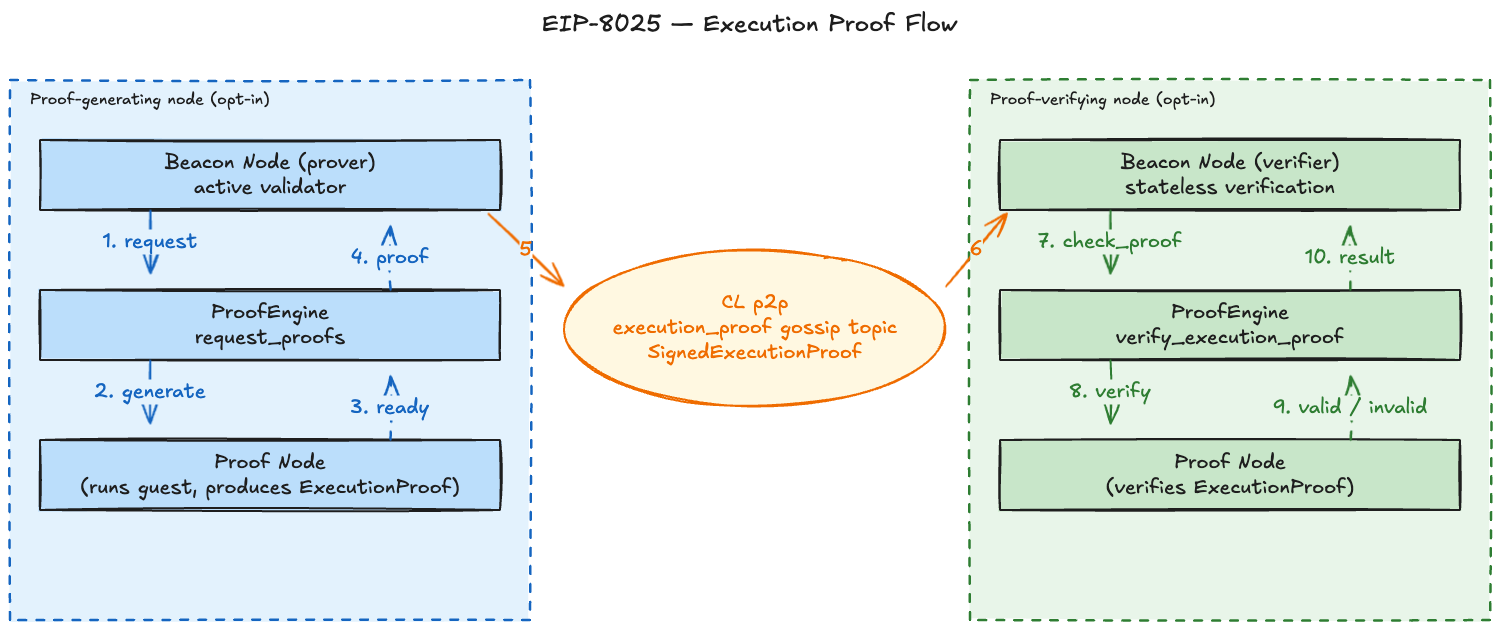
At a high level, the proof lifecycle is:
- A prover reacts to a new beacon block, constructs the corresponding
NewPayloadRequest, and callsproof_engine.request_proofs(new_payload_request, ProofAttributes(proof_types))to initiate proof generation for its configuredproof_typeson the proof node. - The proof node produces an
ExecutionProoffor each requested type. The prover signs each proof, wraps it in aSignedExecutionProof, and broadcasts it on theexecution_prooftopic. - Proof-verifying peers receive the gossip message, run the gossip
validation rules, then call
proof_engine.verify_execution_proofon the innerExecutionProofto confirm payload validity.
This lifecycle uses the execution-validation window introduced by EIP-7732, which defers execution validation until the next beacon block and provides additional time for proof generation.
Sync support requirement. Independent of the request/produce/verify
loop above, every proof-aware node MUST retain valid proofs for
canonical-chain blocks back to the finalised checkpoint so that peers
syncing or filling gaps can backfill them via ExecutionProofsByRange
and ExecutionProofsByRoot (see Req/resp domain for
the protocol details).
Proof types and containers
The consensus layer introduces a small set of new types and constants to identify proofs, bound their size, and route gossip signatures:
| Name | Value |
|---|---|
ProofType |
uint8 |
MAX_PROOF_SIZE |
409600 (= 400 KiB) |
MAX_EXECUTION_PROOFS_PER_PAYLOAD |
uint64(4) |
DOMAIN_EXECUTION_PROOF |
DomainType('0x0D000000') |
MAX_PROOF_SIZE is set at 400 KiB as a network-bandwidth budget: at the
gossip target of one proof per (payload, proof_type) and the cap of
MAX_EXECUTION_PROOFS_PER_PAYLOAD = 4 proof types per payload, the
worst-case in-flight proof bandwidth per slot is 4 × 400 KiB = 1.6 MiB
— of a similar order to existing per-slot blob-sidecar traffic. This
bounds steady-state traffic. Provers using systems that naturally
produce larger proofs are expected to apply proof compression
(recursion, succinct wrappers) before gossiping.
Peers advertise their supported proof types via
ExecutionProofStatus (see Req/resp domain). The set
of proof_types a node speaks is a per-node, dynamic configuration; new
proof systems can be added by socialising a new ProofType value
out-of-band and rolling it out to consenting operators. Proof-system
support is local, opt-in configuration and does not change consensus
validity rules. Peers discover which proof types overlap during their
ExecutionProofStatus handshake and route requests accordingly.
The top-level gossip message is the SignedExecutionProof:
class SignedExecutionProof(Container):
    message: ExecutionProof
    validator_index: ValidatorIndex
    signature: BLSSignature
Its inner ExecutionProof couples a serialised proof blob to the proof
system and guest program it was generated against, and to the public
input that identifies the payload it certifies:
class ExecutionProof(Container):
    proof_data: ByteList[MAX_PROOF_SIZE]
    proof_type: ProofType
    public_input: PublicInput


class PublicInput(Container):
    new_payload_request_root: Root
    successful_validation: boolean
    chain_id: uint64
    schema_id: uint16
The fields play the following roles:
proof_datais the proof system’s serialised output. It is the only field whose size scales with the prover output and is bounded byMAX_PROOF_SIZE.proof_typeselects which proof system and guest program the verifier dispatches to.public_input.new_payload_request_rootis the SSZhash_tree_rootof the Engine APINewPayloadRequestwhose execution this proof certifies. It is the link between a proof and a specific execution payload; verifiers use it to bind the proof to the payload they are verifying.public_input.successful_validationisTrueif the guest program accepted the payload as valid. Verifiers MUST check this field isTruebefore treating the proof as a positive validity signal.public_input.chain_idandpublic_input.schema_idpin the chain and the exact input schema and fork rules the guest was run against, preventing cross-chain replay and fork mismatch.PublicInputmirrors the guest’sStatelessValidationResult, defined in the Execution Layer section.validator_indexandsignatureidentify the prover and prove that they signed the proof underDOMAIN_EXECUTION_PROOF, allowing peers to attribute invalid proofs to a specific active validator.
Proof engine interface
The ProofEngine interface encapsulates the proof-system-specific logic
so that the consensus layer stays agnostic of which proof system is in
use. It acts as a payload-validity oracle for the beacon node, and its
API shape is modelled on the Engine API to allow for seamless
integration into the protocol. The ProofEngine is realised as an
in-client component that maintains its own proof state and delegates
the cryptographic work of proof generation and verification to an
external proof node, mirroring the way the ExecutionEngine delegates
payload execution to the EL client. The
interface comprises four operations and a ProofAttributes type:
def verify_execution_proof(
    self: ProofEngine,
    execution_proof: ExecutionProof,
) -> bool: ...


def notify_new_payload(
    self: ProofEngine,
    new_payload_request: NewPayloadRequest,
) -> None: ...


def notify_forkchoice_updated(
    self: ProofEngine,
    head_block_hash: Hash32,
    safe_block_hash: Hash32,
    finalized_block_hash: Hash32,
) -> None: ...


@dataclass
class ProofAttributes:
    proof_types: Sequence[ProofType]


def request_proofs(
    self: ProofEngine,
    new_payload_request: NewPayloadRequest,
    proof_attributes: ProofAttributes,
) -> Root: ...
These operations decompose into three concerns:
- Verification (
verify_execution_proof) is called on every incoming proof that passes gossip validation. The engine performs the proof-system-specific cryptographic verification and binds the result to the specific payload identified byproof.public_input.new_payload_request_root. A payload is considered proof-verified oncekvalidSignedExecutionProofs for it have been verified. The value ofkwill be pinned before this EIP transitions toReview; it is intentionally left open while the network gathers real-world data. Peers exchange their current proof-verification view viaExecutionProofStatus. - Lifecycle notifications (
notify_new_payload,notify_forkchoice_updated) keep the engine in sync with the state of the beacon node.notify_new_payloadlets the engine associate incoming proofs with the payloads they certify;notify_forkchoice_updatedlets it track the canonical chain to drive proof retention and pruning. - Generation (
request_proofs) is used by proof-generating nodes to trigger asynchronous proof generation for a given payload and set of proof types. The return value isnew_payload_request.hash_tree_root(), which the prover uses as a request id to correlate the proof-completion SSE event the proof node emits when a proof is ready to be fetched.
Beacon-chain state transition
EIP-8025 extends process_block to forward execution payload processing to
both the execution engine and the proof engine, and introduces a new
process_execution_proof handler for incoming proofs.
process_block is modified to pass PROOF_ENGINE to
process_execution_payload:
def process_block(state: BeaconState, block: BeaconBlock) -> None:
    process_block_header(state, block)
    process_withdrawals(state, block.body.execution_payload)
    # [Modified in EIP8025]
    process_execution_payload(state, block.body, EXECUTION_ENGINE, PROOF_ENGINE)
    process_randao(state, block.body)
    process_eth1_data(state, block.body)
    process_operations(state, block.body)
    process_sync_aggregate(state, block.body.sync_aggregate)
process_execution_payload is modified to additionally notify the proof
engine of the new payload after the execution engine has accepted it.
This hook lets the proof engine learn of each new payload so it
can associate it with the proofs that certify it as they arrive over
gossip:
def process_execution_payload(
    state: BeaconState,
    body: BeaconBlockBody,
    execution_engine: ExecutionEngine,
    proof_engine: ProofEngine,
) -> None:
    ...
    # Verify the execution payload is valid via ExecutionEngine
    assert execution_engine.verify_and_notify_new_payload(
        NewPayloadRequest(...)
    )

    # [New in EIP8025]
    # Notify ProofEngine of the new execution payload
    proof_engine.notify_new_payload(NewPayloadRequest(...))
    ...
A new process_execution_proof handles a SignedExecutionProof once it has
passed gossip validation. It re-checks that the prover is active in the
current state, verifies the BLS signature under DOMAIN_EXECUTION_PROOF,
and delegates cryptographic verification to the proof engine:
def process_execution_proof(
    state: BeaconState,
    signed_proof: SignedExecutionProof,
    proof_engine: ProofEngine,
) -> None:
    proof_message = signed_proof.message

    # Verify prover is an active validator
    validator = state.validators[signed_proof.validator_index]
    assert is_active_validator(validator, get_current_epoch(state))

    domain = get_domain(state, DOMAIN_EXECUTION_PROOF, compute_epoch_at_slot(state.slot))
    signing_root = compute_signing_root(proof_message, domain)
    assert bls.Verify(validator.pubkey, signing_root, signed_proof.signature)

    # Verify the execution proof
    assert proof_engine.verify_execution_proof(proof_message)
process_execution_proof is invoked outside the beacon-block state-transition
function and produces no on-chain state change: it is the operational hook
that lets a node decide whether to treat a gossiped proof as a valid
validity signal for an execution payload. Proof storage is managed by the
ProofEngine; retention is bounded by proof_serve_range (see
Req/resp domain): clients MUST retain proofs for
canonical-chain blocks
back to the finalised checkpoint so they can serve ExecutionProofsByRange
and ExecutionProofsByRoot requests.
Proof gossip
Execution proofs are gossiped over a new global topic, execution_proof,
carrying SignedExecutionProof messages. Each rule below is a libp2p
gossipsub validation rule, following the same [IGNORE] / [REJECT]
conventions used by the other beacon-node gossip topics. With
proof = signed_execution_proof.message:
- [IGNORE] the proof’s
new_payload_request_roothas been seen via gossip or non-gossip sources (clients MAY queue proofs until the corresponding payload arrives). - [IGNORE] no valid proof has already been received for the tuple
(new_payload_request_root, proof_type)— i.e. only the first valid proof of each type per payload is forwarded. - [IGNORE] this is the first proof received for the tuple
(new_payload_request_root, proof_type, validator_index)— i.e. each prover gets one shot per(payload, proof_type). - [REJECT] the validator at
validator_indexis an active validator. - [REJECT] the BLS signature is valid for the prover’s public key under
DOMAIN_EXECUTION_PROOF. - [REJECT]
proof.proof_datais non-empty and no larger thanMAX_PROOF_SIZE. - [REJECT] all of the checks in
process_execution_proofpass.
These rules compose with the existing gossipsub peer-scoring machinery: a
peer relaying messages that hit [REJECT] is downscored by the same
mechanism that scores misbehaviour on any other CL gossip topic. The
[IGNORE] rules bound steady-state bandwidth — once a node has a valid
proof for a given (new_payload_request_root, proof_type), additional
proofs for the same tuple are dropped silently, regardless of who signs
them.
Req/resp domain
Three req/resp protocols let peers backfill, target, and coordinate proof state:
ExecutionProofsByRange— request(start_slot, count, proof_types), responseList[SignedExecutionProof]. MirrorsBlobSidecarsByRangeandDataColumnSidecarsByRange: range-based, root-unaware, filtered by proof type. Used for bulk backfill of proofs after a syncing window.ExecutionProofsByRoot— requestList[ProofByRootIdentifier]where each identifier carries(block_root, List[proof_type]), responseList[SignedExecutionProof]. Used for targeted retrieval when a node knows the specific block roots whose proofs it is missing.ExecutionProofStatus— request and response share the same container:(block_root, slot, proof_types). Peers exchange the most recent block they consider proof-verified, plus their dynamically advertised set of supported proof types. The dialing peer MUST send a status on first connecting to any proof-aware peer. This is similar in nature to the beacon-chainStatus v2handshake.
Clients MUST serve both range and root requests for any block on the
canonical chain whose slot is in proof_serve_range — defined as
[finalized_checkpoint.slot, current_slot]. Peers unable to reply respond
with 3: ResourceUnavailable and MAY be descored. The shape of these
protocols composes with existing sync flows: a node syncing forward over
blocks pulls proofs by range; a node patching a specific gap pulls them by
root.
Discovery
Discovery is extended with a new Ethereum Node Record (ENR) key, eproof, encoded as a uint8. A
node is considered proof-aware if the field is present and non-zero,
allowing other peers to filter for proof-aware peers during discovery. This
mirrors the existing pattern used to advertise data-column awareness in
Fulu via the
cgc ENR field
and is intentionally cheap: no fork or fork-version bump is required for a
node to start (or stop) advertising proof support.
Prover lifecycle
The prover lifecycle is illustrated below:
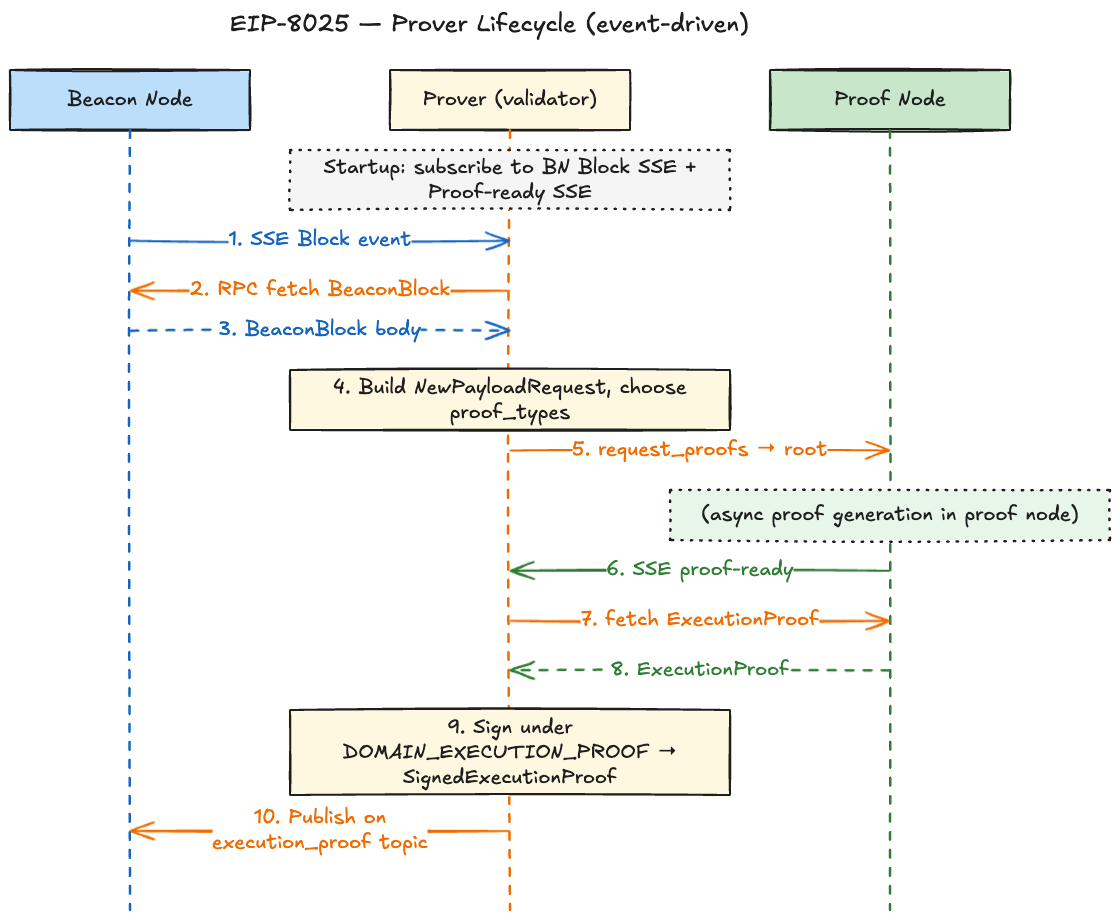
A prover’s flow, as detailed in the prover guide referenced above, is fully event-driven:
- Subscribe to two SSE event streams at startup:
Blockevents from the beacon node, signalling that a new valid beacon block has been received.- Proof-completion events from the proof node.
- On a
Blockevent, fetch the fullBeaconBlockvia RPC, construct the correspondingNewPayloadRequest, choose theProofAttributes(set ofproof_typesthe prover wants to generate), and callproof_engine.request_proofs(...). The returned root is used to track the request. - On a proof-completion event matching a tracked root, fetch the
completed
ExecutionProoffrom the proof node, sign it underDOMAIN_EXECUTION_PROOF, wrap it in aSignedExecutionProof, and broadcast on theexecution_proofgossip topic.
The signing helper is:
def get_execution_proof_signature(
    state: BeaconState, proof: ExecutionProof, privkey: int
) -> BLSSignature:
    domain = get_domain(state, DOMAIN_EXECUTION_PROOF, compute_epoch_at_slot(state.slot))
    signing_root = compute_signing_root(proof, domain)
    return bls.Sign(privkey, signing_root)
The prover role is scoped to the optional-proof phase. If a future EIP were to make execution proofs mandatory, proof generation would plausibly move into block production, at which point the prover role and the optional gossip topic could be deprecated in favour of in-block proof commitments.
Execution Layer
This EIP introduces a stateless execution guest and prover-side logic that
constructs the guest input. The prover runs the guest over private
StatelessInput bytes. The proof exposes StatelessValidationResult as public
output. This output binds the proof to the payload request and execution schema.
A proof-verifying node accepts the execution-layer result only if:
- the proof verifies for the expected guest program.
successful_validationistrue.new_payload_request_rootequals the SSZhash_tree_rootof theNewPayloadRequestassociated with the payload being validated.chain_idandschema_idmatch the values expected by the verifier.
At a high level, proof generation follows this flow:
- A host, usually a stateful execution-layer client, executes or constructs the block while recording the account, storage, code, and ancestor-header data used during execution.
- The host builds an
ExecutionWitnessand combines it with the Engine API request and chain ID. - The host serializes this
StatelessInputas schema-prefixed SSZ bytes. - A prover runs the guest program on the serialized
StatelessInput. - The guest validates the witness and executes the payload against
witness-backed state. It then returns
StatelessValidationResult.
Stateless input and output
The containers below use the progressive containers and lists of EIP-7688. Progressive lists and progressive byte lists do not use fixed capacity constants. The schema keeps these fixed bounds:
| Bound | Value |
|---|---|
MAX_EXTRA_DATA_BYTES |
32 |
MAX_WITNESS_HEADERS |
256 |
MAX_BYTES_PER_CODE |
2**16 |
MAX_BYTES_PER_HEADER |
2**10 |
MAX_BYTES_PER_WITNESS_NODE |
2**10 |
The top-level guest input is private prover input:
class StatelessInput(Container):
    new_payload_request: NewPayloadRequest
    witness: ExecutionWitness
    chain_id: uint64
The guest output is public:
class StatelessValidationResult(Container):
    new_payload_request_root: Bytes32
    successful_validation: boolean
    chain_id: uint64
    schema_id: uint16
At this level:
new_payload_requestis the Engine API payload data supplied by the consensus layer.witnessis the account, storage, code, and ancestor-header data needed to execute the payload without local EL state.chain_ididentifies the chain used during payload validation and execution.schema_ididentifies the exact input schema and fork rules that the guest executed.
If the guest cannot decode the input or cannot produce a validation result, it
returns a failed result with sentinel values. The request root, chain ID, and
schema ID are all zero in this result, so a zero schema_id identifies it. If
validation fails after decoding, the result retains the decoded request root,
chain ID, and schema ID.
The NewPayloadRequest commits to the payload, blob versioned hashes,
parent_beacon_block_root, and typed execution requests.
The versioned_hashes field carries the versioned hashes introduced by
EIP-4844. The typed deposit, withdrawal, and consolidation
requests are specified by EIP-6110,
EIP-7002, and EIP-7251, respectively.
Builder deposit and exit requests are specified by
EIP-8282.
The block_access_list field in ExecutionPayload is the block-level access
list defined by EIP-7928.
class NewPayloadRequest(Container):
    execution_payload: ExecutionPayload
    versioned_hashes: ProgressiveList[Bytes32]
    parent_beacon_block_root: Bytes32
    execution_requests: ExecutionRequests


class ExecutionPayload(
    ProgressiveContainer(active_fields=[1] * 19)
):
    parent_hash: Bytes32
    fee_recipient: ByteVector[20]
    state_root: Bytes32
    receipts_root: Bytes32
    logs_bloom: ByteVector[256]
    prev_randao: Bytes32
    block_number: uint64
    gas_limit: uint64
    gas_used: uint64
    timestamp: uint64
    extra_data: ByteList[MAX_EXTRA_DATA_BYTES]
    base_fee_per_gas: uint256
    block_hash: Bytes32
    transactions: ProgressiveList[ProgressiveByteList]
    withdrawals: ProgressiveList[Withdrawal]
    blob_gas_used: uint64
    excess_blob_gas: uint64
    block_access_list: ProgressiveByteList
    slot_number: uint64


class Withdrawal(Container):
    index: uint64
    validator_index: uint64
    address: ByteVector[20]
    amount: uint64
The execution requests are typed containers that match the consensus-layer specs:
class DepositRequest(Container):
    pubkey: ByteVector[48]
    withdrawal_credentials: Bytes32
    amount: uint64
    signature: ByteVector[96]
    index: uint64


class WithdrawalRequest(Container):
    source_address: ByteVector[20]
    validator_pubkey: ByteVector[48]
    amount: uint64


class ConsolidationRequest(Container):
    source_address: ByteVector[20]
    source_pubkey: ByteVector[48]
    target_pubkey: ByteVector[48]


class BuilderDepositRequest(Container):
    pubkey: ByteVector[48]
    withdrawal_credentials: Bytes32
    amount: uint64
    signature: ByteVector[96]


class BuilderExitRequest(Container):
    source_address: ByteVector[20]
    pubkey: ByteVector[48]


class ExecutionRequests(
    ProgressiveContainer(active_fields=[1] * 5)
):
    deposits: ProgressiveList[DepositRequest]
    withdrawals: ProgressiveList[WithdrawalRequest]
    consolidations: ProgressiveList[ConsolidationRequest]
    builder_deposits: ProgressiveList[BuilderDepositRequest]
    builder_exits: ProgressiveList[BuilderExitRequest]
The remaining top-level field defines the witness consumed by the guest:
class ExecutionWitness(Container):
    state: ProgressiveList[ByteList[MAX_BYTES_PER_WITNESS_NODE]]
    codes: ProgressiveList[ByteList[MAX_BYTES_PER_CODE]]
    headers: List[ByteList[MAX_BYTES_PER_HEADER], MAX_WITNESS_HEADERS]
The ExecutionWitness fields have the following roles:
state: RLP-encoded account and storage trie-node preimages needed during execution and state-root recomputation.codes: bytecodes read from the pre-state. Code deployed earlier in the block being executed is not included because the guest observes it during re-execution.headers: RLP-encoded ancestor headers, ordered by block number and ending at the payload parent. The parent header is always present, because the guest validates the payload header against it and takes the pre-state root from it. Older headers reach back to the oldest block whose hashBLOCKHASHreturned during execution. The guest checks that the headers form a contiguous chain and servesBLOCKHASHfrom their hashes.
Guest validation
The guest entry point decodes schema-prefixed SSZ input and runs stateless payload validation. It always serializes a result, including for invalid input.
def _default_failed_stateless_output() -> StatelessValidationResult:
    return StatelessValidationResult(
        new_payload_request_root=Hash32(b"\0" * 32),
        successful_validation=False,
        chain_id=U64(0),
        schema_id=U16(0),
    )


def run_stateless_guest(input_bytes: Bytes) -> Bytes:
    try:
        stateless_input = deserialize_stateless_input(input_bytes)
        stateless_output = verify_stateless_new_payload(stateless_input)
    except Exception:
        stateless_output = _default_failed_stateless_output()
    return serialize_stateless_output(stateless_output)
The main validation path first computes the public payload-request commitment.
It then validates the header witness and creates a WitnessState. Finally, it
uses the same new_payload path as the execution engine.
The reference implementation has one implementation for each fork. Thus, its Amsterdam guest does not compare the payload timestamp with fork activation data. Production implementations MUST perform this comparison.
def compute_new_payload_request_root(
    stateless_input: StatelessInput,
) -> Hash32:
    return Hash32(stateless_input.new_payload_request.hash_tree_root())


def validate_headers(
    encoded_headers: Tuple[Bytes, ...],
) -> Tuple[List[Header | PreviousHeader], List[Hash32]]:
    assert len(encoded_headers) <= MAX_WITNESS_HEADERS
    headers = [_decode_header(header) for header in encoded_headers]
    block_hashes = [keccak256(header) for header in encoded_headers]
    for i in range(1, len(headers)):
        if headers[i].parent_hash != block_hashes[i - 1]:
            raise Exception("Witness headers are not contiguous")
    return headers, block_hashes


def verify_stateless_new_payload(
    stateless_input: StatelessInput,
) -> StatelessValidationResult:
    new_payload_request_root = compute_new_payload_request_root(
        stateless_input
    )
    witness = stateless_input.witness

    try:
        decoded_headers, block_hashes = validate_headers(witness.headers)
        parent_header = decoded_headers[-1]

        chain_context = ChainContext(
            chain_id=stateless_input.chain_id,
            block_hashes=block_hashes,
            parent_header=parent_header,
        )

        pre_state = WitnessState(
            _node_db=build_node_db(witness.state),
            _state_root=parent_header.state_root,
            _code_db=build_code_db(witness.codes),
        )

        execute_new_payload_request(
            stateless_input.new_payload_request,
            pre_state,
            chain_context,
        )
        successful_validation = True
    except Exception:
        successful_validation = False

    return StatelessValidationResult(
        new_payload_request_root=new_payload_request_root,
        successful_validation=successful_validation,
        chain_id=stateless_input.chain_id,
        schema_id=U16(STATELESS_INPUT_SCHEMA_ID),
    )
WitnessState is the stateless replacement for a local pre-state database. It
serves account, storage, and code reads from the witness and computes the
post-state root from the block diff:
class WitnessState:
    _node_db: Dict[Bytes, Bytes]
    _state_root: Root
    _code_db: Dict[Hash32, Bytes]

    def get_account_optional(self, address: Address) -> Optional[Account]: ...
    def get_storage(self, address: Address, key: Bytes32) -> U256: ...
    def get_code(self, code_hash: Hash32) -> Bytes: ...
    def compute_state_root(self, block_diff: BlockDiff) -> Root: ...
A key reads as absent only when the witness contains the trie path that proves its absence. A read fails if the witness lacks a trie node on the path or the requested bytecode, or if a node or leaf is malformed. Any such failure makes validation fail.
The payload execution logic performs the normal payload checks before executing the block:
def execute_new_payload_request(
    new_payload_request: NewPayloadRequest,
    pre_state: PreState,
    chain_context: ChainContext,
) -> Tuple[BlockDiff, Block]:
    payload = new_payload_request.execution_payload

    if b"" in payload.transactions:
        raise InvalidBlock("Empty transaction in payload")
    if not is_valid_block_hash(
        payload,
        new_payload_request.parent_beacon_block_root,
        new_payload_request.execution_requests,
    ):
        raise InvalidBlock("Invalid block hash")
    if not is_valid_versioned_hashes(new_payload_request):
        raise InvalidBlock("Invalid versioned hashes")

    block = _payload_block(
        payload,
        new_payload_request.parent_beacon_block_root,
        new_payload_request.execution_requests,
    )
    block_diff = execute_block(block, pre_state, chain_context)
    return block_diff, block
Host-side input construction
On the host side, build_stateless_input receives the data gathered during
block execution or construction and packages them for the guest:
def build_stateless_input(
    block: Block,
    *,
    execution_witness: ExecutionWitness,
    execution_requests: ExecutionRequests,
    block_access_list: BlockAccessList,
    chain_id: U64,
) -> StatelessInput:
    ...

    payload = ExecutionPayload(
        ...,
        block_access_list=Bytes(rlp.encode(block_access_list)),
        slot_number=header.slot_number,
    )

    new_payload = NewPayloadRequest(
        execution_payload=payload,
        versioned_hashes=tuple(versioned_hashes),
        parent_beacon_block_root=header.parent_beacon_block_root,
        execution_requests=execution_requests,
    )

    return StatelessInput(
        new_payload_request=new_payload,
        witness=execution_witness,
        chain_id=chain_id,
    )
The execution witness is built from the block-level read/write tracker and pre-state trie data. ELs already use this tracker to construct block access lists (BALs). Conceptually, witness construction:
- collects the parent header and any older ancestors whose hashes
BLOCKHASHreturned. - collects bytecode read from the pre-state.
- captures account and storage trie nodes needed for all reads and writes.
- captures potential sibling nodes that branch compression requires during post-state root calculation.
The host records trie nodes with the same lookup that the guest uses for reads. Both sides also apply each storage trie’s insertions and updates before its deletions. A deletion can collapse a branch, and the collapse needs the node of the remaining sibling. Deleting last keeps more branches populated, so fewer collapses happen. Because both sides write in the same order, the guest never needs a sibling node that the host did not record.
def build_execution_witness(
    block_state: BlockState,
    expected_post_state_root: Root,
    pre_state_accounts_data: Trie[Address, Optional[Account]],
    pre_state_storages_data: Dict[Address, Trie[Bytes32, U256]],
    blockchain_headers: Optional[List[Bytes]] = None,
) -> ExecutionWitness:
    ancestor_headers = get_witness_ancestors(
        blockchain_headers if blockchain_headers is not None else [],
        block_state.oldest_ancestor_offset,
    )
    codes = get_witness_codes(block_state.code_reads, block_state.pre_state)

    incr_storage_mpts = _build_pre_state_storage_mpts(pre_state_storages_data)
    incr_account_mpt = _build_pre_state_account_mpt(
        pre_state_accounts_data, incr_storage_mpts
    )

    all_storage_accesses = _collect_storage_accesses(block_state)
    _capture_pre_state_storage_nodes(incr_storage_mpts, all_storage_accesses)
    _apply_storage_writes(incr_storage_mpts, block_state.storage_writes)

    all_dirty_accounts = _get_all_dirty_accounts(block_state)
    _capture_pre_state_account_nodes(
        incr_account_mpt,
        block_state.account_reads,
        all_dirty_accounts,
    )
    _apply_account_writes(
        incr_account_mpt,
        incr_storage_mpts,
        block_state,
        all_dirty_accounts,
    )

    assert mpt_root(incr_account_mpt) == expected_post_state_root

    accessed_nodes = _collect_accessed_nodes(
        incr_account_mpt, incr_storage_mpts
    )

    return ExecutionWitness(
        state=tuple(sorted(accessed_nodes.values())),
        codes=tuple(codes),
        headers=tuple(ancestor_headers),
    )
SSZ encoding
The host serializes a StatelessInput by prefixing the SSZ bytes with a
two-byte schema ID. The high byte identifies the fork, and the low byte
identifies the schema revision. Amsterdam revision 1 uses schema ID 0x1501.
class ProtocolFork(IntEnum):
    ...
    Amsterdam = 0x15


STATELESS_INPUT_SCHEMA_FORK_INDEX = ProtocolFork.Amsterdam
STATELESS_INPUT_SCHEMA_REVISION = 0x01
STATELESS_INPUT_SCHEMA_ID = (
    STATELESS_INPUT_SCHEMA_FORK_INDEX << 8
) | STATELESS_INPUT_SCHEMA_REVISION
STATELESS_INPUT_SCHEMA_ID_SIZE = 2
STATELESS_INPUT_SCHEMA_ID_BYTES = STATELESS_INPUT_SCHEMA_ID.to_bytes(
    STATELESS_INPUT_SCHEMA_ID_SIZE,
    "big",
)


def serialize_stateless_input(
    stateless_input: StatelessInput,
) -> Bytes:
    return Bytes(
        STATELESS_INPUT_SCHEMA_ID_BYTES + stateless_input.encode_bytes()
    )


def deserialize_stateless_input(data: Bytes) -> StatelessInput:
    if len(data) < STATELESS_INPUT_SCHEMA_ID_SIZE:
        raise ValueError("Stateless input is missing schema id")
    schema_id = int.from_bytes(
        data[:STATELESS_INPUT_SCHEMA_ID_SIZE],
        "big",
    )
    if schema_id != STATELESS_INPUT_SCHEMA_ID:
        raise ValueError(
            f"Unsupported stateless input schema id: 0x{schema_id:04x}"
        )
    return StatelessInput.decode_bytes(data[STATELESS_INPUT_SCHEMA_ID_SIZE:])
The guest MUST accept only the canonical SSZ encoding of a StatelessInput.
The reference decoder re-encodes the decoded value and rejects the input
unless the bytes match exactly. This check rejects offset gaps and unread
trailing bytes, including those inside nested containers.
The guest output is the SSZ encoding of StatelessValidationResult. Its
schema_id field reports the exact input schema that the guest executed.
Rationale
Path to low-resource validation
This step moves the network measurably closer to low-resource validation. Stateless, constant-time payload verification breaks the coupling between a node’s hardware requirements and the gas limit or state size, lowering the floor for who can meaningfully run a node and improving decentralisation.
Build operational experience
The central design choice is to deploy execution proofs as an opt-in feature. Stateless validation, the witness format, and the proof system itself are maturing, but we need operational experience before making execution proofs load-bearing. Treating execution proofs as a non-critical artefact lets the stack mature on a live network — proof sizes, generation latency, verifier throughput, gossip behaviour, prover diversity — without placing any of that on the path of fork choice or attestation. A bug, outage, or poor parameter choice is contained to the nodes that opted in; it cannot fork the chain or affect validators that did not subscribe.
Backwards Compatibility
This EIP is fully opt-in and does not change consensus validity rules. Validators that do not enable either mode see no change to their behaviour, their bandwidth, or their attestation duties. Nodes that opt in additionally subscribe to the proof gossip topic, advertise themselves via the eproof ENR field, and may run a prover; this affects only their local resource profile.
Test Cases
Conformance tests are maintained in the canonical specification repositories:
Guest programs should run the blockchain_test_engine fixtures rather than
blockchain_test. Because StatelessInput wraps an Engine API
NewPayloadRequest, the engine fixtures cover more invalid-payload mutations.
Reference Implementation
Security Considerations
Gossip surface. Proofs are carried over a new gossipsub topic with payload size bounded by MAX_PROOF_SIZE. Validation, anti-DoS rate limits, and peer scoring for invalid proofs follow the same patterns as other CL gossip topics; a misbehaving peer is bounded and can be downscored.
Soundness and consensus implications. This EIP does not wire proof verification into fork choice or any other consensus rule: process_execution_proof runs outside the beacon-block state-transition function. A forged proof therefore cannot fork the chain, slash a validator, or otherwise affect consensus state — its effect is bounded to a verifying node’s local view of payload validity.
Liveness and critical-path latency. Proof generation and verification are off the attestation hot path. Validators must not delay block validation or attestation production while waiting for a proof; if a proof is missing or late, the node attests using the fork choice determined by the execution engine’s re-execution of payloads.
Verifier–prover decentralisation asymmetry. Stateless, constant-time payload verification lowers the resource floor for validators, but proof generation itself remains demanding: a prover must hold the full EL state used during execution and run a non-trivial proving stack whose cost scales as O(n log² n) in the size n of the witnessed computation. If the proportion of verifying-only nodes grows faster than the proportion of nodes able to generate proofs, the set of actors who maintain the full EL state and produce proofs may become more concentrated even as overall validator participation broadens.
Copyright
Copyright and related rights waived via CC0.
Citation
Please cite this document as:
Kevaundray Wedderburn (@kevaundray), Justin Drake (@JustinDrake) <justin@ethereum.org>, Ignacio Hagopian (@jsign), Han (@han0110), Francesco Risitano (@frisitano), Cody Gunton (@codygunton), "EIP-8025: Optional Execution Proofs [DRAFT]," Ethereum Improvement Proposals, no. 8025, September 2025. Available: https://eips.ethereum.org/EIPS/eip-8025.